Thursday, 8 August 2019

Pattern in art

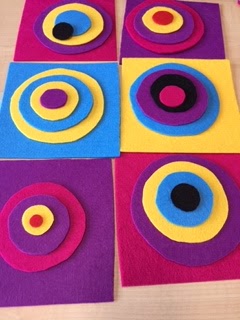
Some classes have been looking at pattern in art. We studied some works by M.C.Escher and looked at tessellation. Kids tried their own tessellations - there were some great imaginative ideas created. Some looked at the work of Kandinsky and the use of circles in various patterns. They experimented with felt squares and circles to create their own Kandinsky-like art pieces.
Some experimented with tangrams to see what designs they could come up with, and some created as many different patterns as they could think of.
Next week we'll be looking at pattern in nature and the fibonacci sequence.
Look around you - where do you see pattern?


Robotics


We are very excited to have some newly purchased 'Edison' robots at school. These are available to
all teachers to use with their classes, but as I organised them and set them up the Quest kids got to use them first. Some have used them with me before at Science class or in Quest (I have my own set of 8).  We looked at programming as being like a recipe - giving instructions to the robot. We also looked at how robots can help us (and times when robots go wrong - have you seen the videos of roomba robotic vacuums running over dog poo ? Ewww!!!) When using robots it's good for kids to see that it is a process. We think, plan, try something, and if it doesn't work as we wanted then we change something.  This is very much in line with the engineering process that the year 5&6's used for our rocket challenge - Ask (what do we want it to do, what;'s the brief?), Imagine, Create, Improve. Here's a slightly expanded illustration of that process.
Image result for engineering process

It's important for kids to see that problem solving is part of the process - great for those with perfectionist tendencies to see that mistakes are ok (and inevitable when programming) and can be worked through. We can ask for help if we're struggling and that's ok - its part of problem solving.
These robots are great as they are hardy, and scaleable - they can be used from 4 year olds (or younger) up to adults. They have pre-programmed barcodes for easy use, and then 3 programming platforms - Edblocks (which most of my groups used), Edscratch - like scratch programming and a step up from Edblocks, and EdPy - based on 'python' programming language, which is aimed for high school aged kids. I had a few try Edscratch (because they wanted to try something harder) and one even had a go at EdPy! It's so great for our gifted kids to be able to choose the level of challenge that suits them!  Edison can sense colour, light, sound, can make sounds and lights go, follow lines, sumo wrestle, etc etc. Edison is also compatible with lego, which adds to the fun - as you can create new looks for Edison. So many possibilities - we'll use them again for sure!




Wednesday, 24 July 2019

TERM 3 - Pattern

This term at Quest we will be looking at the concept of pattern.
We started this week by looking at animal pattern and camouflage. Why do animals camouflage, and how do they camouflage?
One form of camouflage is mimicry - pretending to be something you're not. Take a look at these creatures 'hiding in plain sight' by disguising as something else.


We discussed how and why humans use camouflage, and thought about if we ever camouflage or hide our feelings and whether we should. 

Other pattern topics I hope to look at this term include pattern in art, fibonacci and pattern in nature, cultural patterns, design and architecture, breaking a pattern, and robotics. Here's hoping I get time to cover them all! 

Tuesday, 25 June 2019

Rocket Challenge

Our year 5&6 Quest groups have been taking part in Engineering New Zealand’s Rocket Challenge
this term. They have learnt about Newton’s Laws and the engineering process while developing their
own rockets. The groups have been lucky enough to have engineers volunteer their time to work with
them and guide their learning. Thanks to Dr Fei Ying - senior lecturer at AUT school of engineering,
and James Tayler - helicopter pilot and trainer, for the time given to inspire learning for our students.


Last week we were lucky enough to have a visit from an engineer from Rocket Lab. Kieran Fanning talked to the students about his pathway to working at rocket lab, and how they design and make rockets that go to space. These rockets are launched from Mahia Peninsula near Gisborne. The students were amazed to hear that the engines for the rockets are 3D printed. They heard how new smaller technology contributes to smaller satellite designs, which means smaller rockets can be used to launch them. It was very exciting to hear from someone who works with rockets for a job, and get to see the model of the electron rocket too. This has inspired our students to try to design more efficient rockets, using the engineering process to improve their designs. Thanks Kieran and Rocket Lab for making this visit happen and for supporting our students’ learning. The next Rocket Lab launch is happening within the next two weeks. There will be a live video stream of the launch when it happens. Check out their website.


Thursday, 6 June 2019

Parent Evening - 'Gifted 101'

Image result for gifted children domainsWhat is giftedness? At a recent parent evening I talked about the different domains (areas) of giftedness and how we identify and cater for our gifted students at Whangaparaoa School. We also looked at positive and negative behaviours sometimes present in gifted children (eg they may have advanced vocab, but this may also mean they can use words to manipulate - can be good debaters and future politicians I guess!)
Here is a link to the slides from the evening if you are interested. 'Gifted 101'

Prototypes and test flights

The year 5&6 rocket challenge is developing well. We have looked at Newton's laws, aerodynamics, design ideas etc and teams have created their prototypes. The Tuesday group carried out their test flights this week. Our engineer ambassador, Dr Fei Ying (AUT senior lecturer - civil engineering), helped us think about experimenting with thrust by differing the PSI and the water volume in our rockets. We had lots of people stop to watch - it was a lot of fun!

The Wednesday group have their prototypes ready to test next week if the weather is right. They had great fun a couple of weeks ago with their engineer ambassador, James Tayler (Helicopter trainer and rescue helicopter pilot), testing aerodynamics with paper planes, and also looking at Newton's third law (F = m a). We tested how much force was needed to accelerate different masses, using a giant slingshot that James had made.


Challenges of life in the desert


Related image


Image result for wildboy expedition dustBrando Yelavich, aka 'Wildboy', is currently attempting to cycle across the width of Australia, through the outback. The kids learnt a little about him last term when we were looking at exploration. A few years ago Brando walked around the entire coastline of NZ, and popped in to Whangaparaoa Primary to give a talk along the way. His story of determination, perseverance and problem solving is inspiring.
So now we are following along as he cycles through the desert. We looked at what would be essential to pack, to help someone  survive in a desert. Lots of thinking and debating about what is important. Lots of questions too - how can you carry enough water? How much water do you need each day? How can you charge a phone or camera? How do you carry enough food?
Here is a link to Brando's blog if you would like to follow along. He also has a facebook page, and some of the kids have had me communicate with him (they wanted to know how he takes photos of himself cycling if he's by himself). Brando very kindly answered us - the kids were excited!

Image result for thorny devilWe looked at where deserts of the world are, using google maps and atlas'. We looked at why there are deserts, and conditions in a desert. Some studied animals in the desert (survival techniques they use - check out the 'thorny devil' from Australia which gathers dew drops on its back as it walks past desert grasses). Some designed houses for the desert - how would you get water, power, shade etc?

TERM 2 2026 - Movement

  MOVEMENT DEFINITIONS: A change in position or location A particular action or way of changing place or position A group or groups of peopl...