Tuesday, 28 May 2019

Challenges faced by differently abled people

Try this. Clench your hands into fists and pretend you have no hands. Now try doing some everyday tasks without using your fingers at all - put on a shirt, open a jar, write your name, open a wrapped lolly... these are some of the activities the year 2-4 Quest kids tried. We talked about how we felt doing these challenges, and how we could deal with these feelings. We looked at strategies to help with the frustration and we discussed the triumph experienced when we managed to overcome difficulties.
I then showed the kids a video of a truly inspiring young lady - Sara Hinesley - who was born without hands. She has recently won a handwriting award. Her determination and perseverance are inspiring.

You might like to look up Nick Vuicich for another amazing example of persevering against the odds. Nick was born with no arms and no legs - a huge challenge! But he manages to play golf, swim and jump off diving boards, surf, play soccer etc. He is a motivational speaker - powerful!

As it was NZ sign language week close to when we did this topic we also looked at being deaf and what challenges that would have. We learnt a little sign language and tried out lip reading.
Some looked at the challenges of limited or no eyesight. Some looked at learning difficulties such as dyslexia and challenges that come with that.

Hopefully this will develop some empathy, and also some skills for dealing with challenges we face and the associated feelings we have - frustration, anger, defeat, disappointment, determination, etc. We looked at facing these challenges with perseverance, not being afraid to ask for help if needed, using techniques to calm ourselves if feeling frustrated (deep breathing, take a walk, have a break, try something different etc).


Wednesday, 22 May 2019

CHALLENGE

This term we have the exciting concept of Challenge. We will be challenging ourselves and looking at challenges that others face. Along the way we will be thinking about how we face challenges - how we feel and react - and learning skills to help us face difficulties and challenge.

The year 5&6 groups are taking part in the wonder project rocket challenge, organised by Engineering NZ. We will be looking at rocket design, the engineering process, Newton's Laws, and finishing with a competition to see whose rocket can go the highest. We are very lucky to have an engineer working with each group - generously giving their time to come and inspire our possible future engineers. Thanks to Dr Fei Ying, senior lecturer from AUT, and James Tayler, Helicopter pilot and trainer, for giving up their time.


The year 2-4 students are looking at a  variety of topics to do with challenge - being differently abled, puzzles, living in challenging places, design and creativity, facing fears etc. One group was lucky enough to have a naval design engineer and AUT lecturer come in to work with them as they learnt about boat design and tested buoyancy. Thanks Christian Stimson (Stimson Yacht Design) for a wonderful time learning with you.


Wednesday, 24 April 2019

Exploration continued

Throughout term 1 2019 we looked at exploration - from topics such as exploring our imaginations (creativity), to learning about explorers and qualities they need / have, to possible future exploration. This is a good website to look at the history of space exploration and possible future missions.  We debated whether or not we should be spending money on exploring space - lots of interesting viewpoints. The point of debates during Quest is not to decide right or wrong, but to open thinking up so that we can see different points of view and consider our own points of view.


As luck would have it, the week we were looking at space and future exploration, there was the announcement about the black hole image, so we looked briefly at Dr Katie Bouman and those who helped explore new possibilities when rendering an image of a black hole. 
There is so much to explore - from the minuscule to the huge, from internal to external. All we need is curiosity, determination, perseverance, certain skills, possibly help (or to know where to get help if needed) and we can all be explorers of something!

Tuesday, 19 March 2019

Kupe and te wheke - a legend of early Maori exploration

Who discovered NZ? Some would say Abel Tasman, some say Captain James Cook. Yes they were early European explorers, but the maori were here long before then.

This week we re-enacted the legend of Kupe and te wheke (the octopus). It is the story of how Maori moved across te moana nui a kiwa (the pacific ocean) and came to Aotearoa from Hawaiiki (popularly thought to be Raiatea north of Tahiti).
Here is a link to the legend version we acted out.


Again we looked at traits of explorers - bravery, curiosity, resilience, determination, problem-solving, having particular skills and knowledge. We discussed navigation by the stars and the sun. We looked at the possibility of this legend being based on truth. Is there anything in the legend that happens in real life? Could Kupe have sailed that far? We looked at people from around the Pacific Islands, including NZ, who have recreated this waka journey using traditional methods to keep the traditions and skills alive.

Saturday, 9 March 2019

Sea Week

Think about explorers - what dispositions do you think they have or need? 

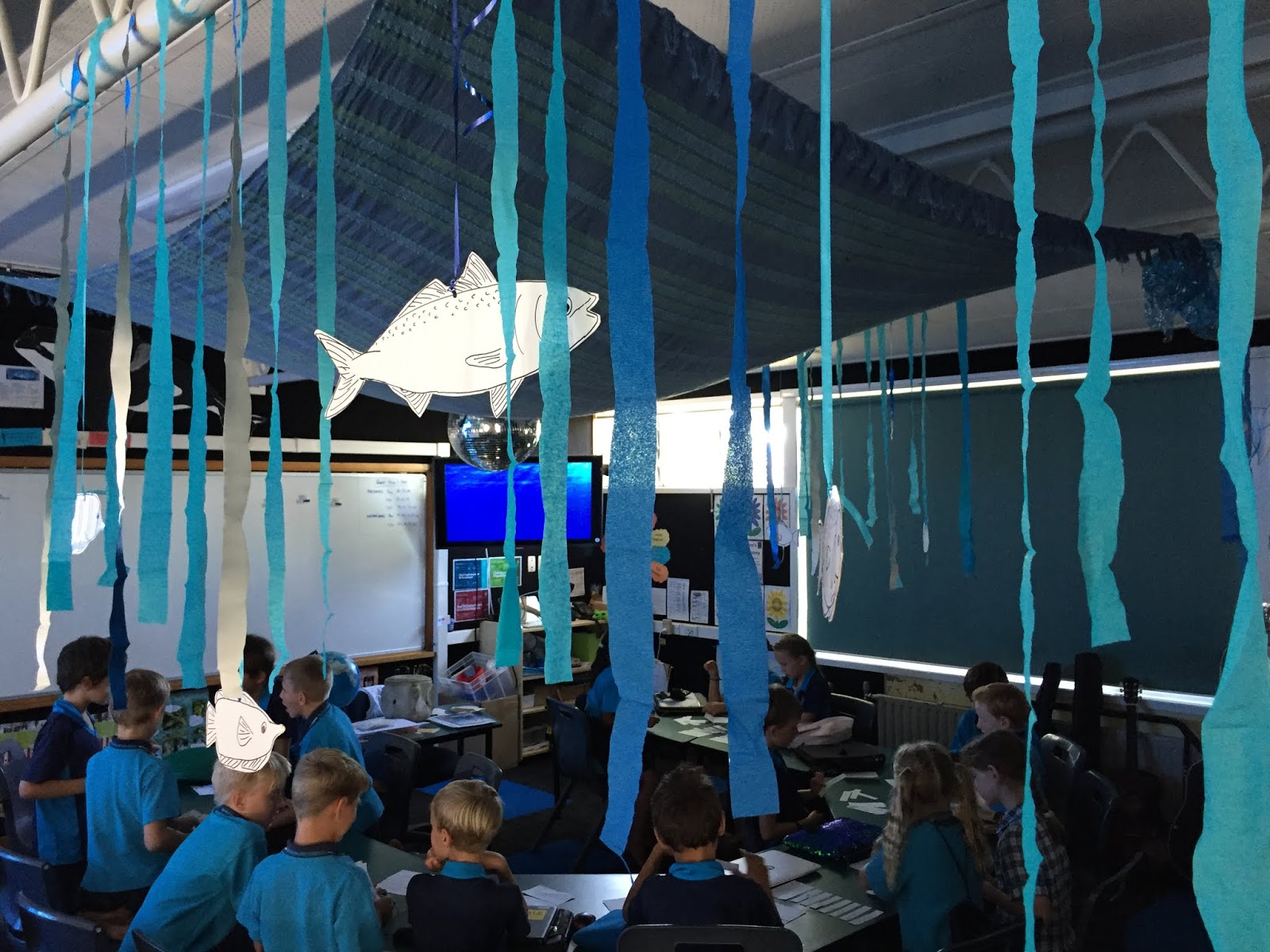
This week we looked at ocean explorers as it was sea week. The kids arrived to a classroom that was transformed into an underwater land to work in. 

We learnt about ocean explorers like Jaques Cousteau, Sylvia Earle, and of course NZ's own 'Young Ocean Explorers' - Steve and Riley Hathaway. 

We looked at strengths of explorers - having passion, skill, courage, resilience, patience; being problem-solvers, inventive, resourceful. 🐟🐠🐳🐋🦈🦑🦐🦀

Friday, 1 March 2019

Exploring people

Week one of Quest for the year. We are going to be looking at the concept of exploration this term. 

This week we started with a fun cooperative game in teams, and then we looked at the similarities and differences in people - exploring people. 

I asked the children to make a flower or plant with three pipecleaners. No other instructions. I wanted to see their creativity at work, and for them to see that they all think differently and have different skills. Some children immediately started planning - drawing their ideas and executing them precisely (even measuring carefully!). Some discussed their ideas with others. Some sat and watched others. Some just got into it with a clear idea, and some started one idea and changed along the way. It was very interesting to see all the different styles of thinking / creating, and the different outcomes. 

Then I challenged children to think about how people are like flowers. These are some of their ideas:
People and flowers both: Need air, breathe, need sun, need water, die, can get damaged, need care, are beautiful, are different, some smell nice, some are prickly, stand up, need food, can make their own food. 

We discussed a couple of quotes I had, and whether we agreed or disagreed with the statements.


We then talked about outward appearances and whether we can tell things about people by looking at them. They had a picture of a group of children. I asked them to look at it and point to who they think is the rich one, the poor one, the kind one, the mean one, the friendly one, the clever one, the one who needs help with their learning etc. Interestingly some stereotypes seem alive and thriving - most of them pointed to the one with glasses as the clever one! We had some good discussions about outward appearance and what that can and can't show us. Some came up with the saying 'Never judge a book by it's cover.' 

We then watched at a video of a social experiment, where a 6 year old was dressed in tidy clothes and left on a footpath to see how long it would take for her to get noticed and helped. It seemed almost instantly people were asking if she was lost and needed help. Then the same girl was made up to look dirty and unwashed and dressed in scruffy clothes. She was not helped or noticed at all by bystanders when left alone on a footpath. The same thing was tested in a restaurant and people visibly held their handbags closer and shooed her away when she walked up to their tables in her scruffy dirty clothes, yet invited her over and chatted happily when she was in her tidy clothes. Very thought-provoking! We discussed whether the girl's needs  and feelings changed just because she was dressed differently. 

Next we looked at personalities and how we are all different inside and with our thinking and actions. With the year 2-4 students we looked briefly at the book 'The Treasure Tree' and the different personalities (Lion, Golden Retriever, Otter, Beaver). The year 5&6 kids did an online personality test. We discussed the fact that just like plants are classified in groups (eg roses, ferns, daisies etc) we can be too. There are still differences within the group. A personality test can give us an indication of our personality type (depending on how we answer the questions) but we may not be exactly as it says as we are all unique. It is a great discussion starter though - you might like to try this at home and then have a discussion about your personality types. I find this stuff really valuable for helping to understand ourselves and others and the different ways we all think and act. 

Next week we will be looking at explorers, the traits they possess or need, and some NZ explorers. 

Sunday, 17 February 2019

2019 here we come!

Here is the timetable for 'Quest' in term 1. We are starting in week 4 (26/27 Feb).
I start with approx 96 students from year 2-6. More will be added as we identify them this year - most likely several new year 2's throughout the year.

I only work Tuesdays and Wednesdays for Whangaparaoa school.

This term we are looking at Exploration - starting with exploring similarities and differences in people, then looking at some famous explorers and traits they have (resilience, determination, problem solving, courage, curiosity etc).

TERM 2 2026 - Movement

  MOVEMENT DEFINITIONS: A change in position or location A particular action or way of changing place or position A group or groups of peopl...