Wednesday, 4 September 2019

Break the pattern


Over the last two weeks we have looked at breaking patterns that we don't like - changing things for the better. We started by looking at caring for people. In a couple of weeks we will look at caring for the environment in line with Conservation week.

I had a 'school kit' resource called 'Not part of my world' that was developed by educators in response to events in Christchurch this year. It is carefully put together and designed to get kids thinking about their views and actions towards others, being aware of stereotypes and biases, and ensuring we are caring for others and treating them well no matter their differences to us.Last week we looked at stereotypes with a game of stereotype pictionary eg draw a doctor, draw a bad driver, draw a rich person, draw a criminal, draw a New Zealander etc. Think about your own possible biases - do you picture a certain type of person when you think of those mentioned? This opened up some good discussions and got us thinking. All groups also looked at people who are special to them, with a circle of friends / family. We thought about how they make us feel and how they treat us and we treat them. 


This week we looked at treating others nicely, making them feel welcome. We did the compliments project. Each child wrote their name in the middle of a piece of paper, then we all went around and wrote a compliment on each other's paper. It was lovely seeing the thought that went into this, and the look of joy on their faces as they read what positive things others had to say about them. The idea was based on this video.

Here are a few comments children wrote for each other (obviously not a spelling competition...!)  We all left with a warm fuzzy feeling this week :)


Saturday, 24 August 2019

Architecture and engineering

This week at Quest we looked at pattern used in architecture and engineering. First of all the 'pattern' or plan needed to build something - ensuring it looks good, is fit for purpose, and is strong. 
We looked at different pattern used on buildings - line, shape, colour, texture etc. Some groups looked at works of creative architects such as Anton Gaudi and Friedensreich Hundertwasser. 


Many children knew people who are architects or engineers.
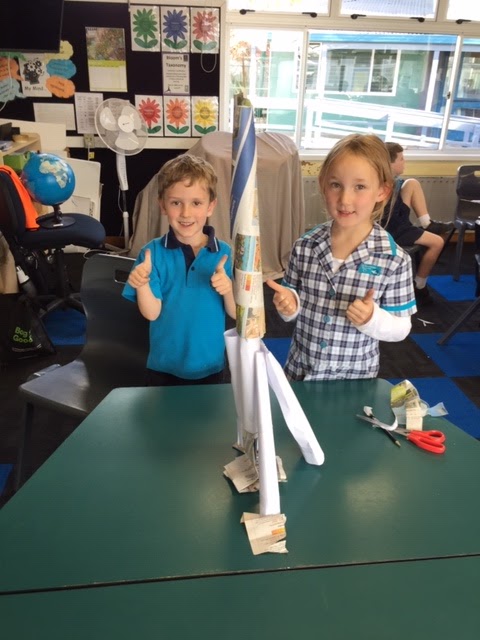
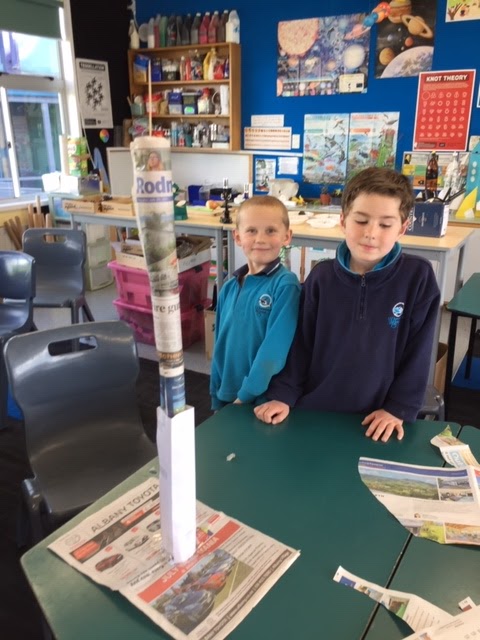
Next we had a challenge to design and build the tallest radio mast tower. The challenge was that we had limited equipment (newspaper and tape), and limited time. We discussed the importance of planning, trying our design, noticing if there were issues (where is it failing or not working) and trying to problem-solve. I was amazed at how many different designs we had and how many children actually got a tower standing. It had to be self-supporting (it couldn't be taped to anything or lean on anything). This was a challenge as children found that when they built high their buildings weren't very stable, so they had to think of ways to strengthen and support them. We had some that were over a metre high - just from 3 flimsy pieces of newspaper - impressive! Lots of amazing problem solving and collaboration this week. This is a good one to try at home - perhaps you could challenge your kids to see who can make the tallest tower out of just 3 sheets of newspaper...


Thursday, 8 August 2019

Pattern in art

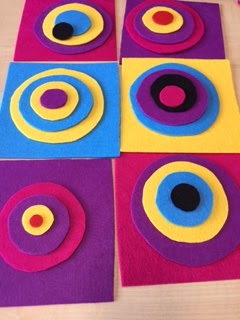
Some classes have been looking at pattern in art. We studied some works by M.C.Escher and looked at tessellation. Kids tried their own tessellations - there were some great imaginative ideas created. Some looked at the work of Kandinsky and the use of circles in various patterns. They experimented with felt squares and circles to create their own Kandinsky-like art pieces.
Some experimented with tangrams to see what designs they could come up with, and some created as many different patterns as they could think of.
Next week we'll be looking at pattern in nature and the fibonacci sequence.
Look around you - where do you see pattern?


Robotics


We are very excited to have some newly purchased 'Edison' robots at school. These are available to
all teachers to use with their classes, but as I organised them and set them up the Quest kids got to use them first. Some have used them with me before at Science class or in Quest (I have my own set of 8).  We looked at programming as being like a recipe - giving instructions to the robot. We also looked at how robots can help us (and times when robots go wrong - have you seen the videos of roomba robotic vacuums running over dog poo ? Ewww!!!) When using robots it's good for kids to see that it is a process. We think, plan, try something, and if it doesn't work as we wanted then we change something.  This is very much in line with the engineering process that the year 5&6's used for our rocket challenge - Ask (what do we want it to do, what;'s the brief?), Imagine, Create, Improve. Here's a slightly expanded illustration of that process.
Image result for engineering process

It's important for kids to see that problem solving is part of the process - great for those with perfectionist tendencies to see that mistakes are ok (and inevitable when programming) and can be worked through. We can ask for help if we're struggling and that's ok - its part of problem solving.
These robots are great as they are hardy, and scaleable - they can be used from 4 year olds (or younger) up to adults. They have pre-programmed barcodes for easy use, and then 3 programming platforms - Edblocks (which most of my groups used), Edscratch - like scratch programming and a step up from Edblocks, and EdPy - based on 'python' programming language, which is aimed for high school aged kids. I had a few try Edscratch (because they wanted to try something harder) and one even had a go at EdPy! It's so great for our gifted kids to be able to choose the level of challenge that suits them!  Edison can sense colour, light, sound, can make sounds and lights go, follow lines, sumo wrestle, etc etc. Edison is also compatible with lego, which adds to the fun - as you can create new looks for Edison. So many possibilities - we'll use them again for sure!


Wednesday, 24 July 2019

TERM 3 - Pattern

This term at Quest we will be looking at the concept of pattern.
We started this week by looking at animal pattern and camouflage. Why do animals camouflage, and how do they camouflage?
One form of camouflage is mimicry - pretending to be something you're not. Take a look at these creatures 'hiding in plain sight' by disguising as something else.


We discussed how and why humans use camouflage, and thought about if we ever camouflage or hide our feelings and whether we should. 

Other pattern topics I hope to look at this term include pattern in art, fibonacci and pattern in nature, cultural patterns, design and architecture, breaking a pattern, and robotics. Here's hoping I get time to cover them all! 

TERM 2 2026 - Movement

  MOVEMENT DEFINITIONS: A change in position or location A particular action or way of changing place or position A group or groups of peopl...